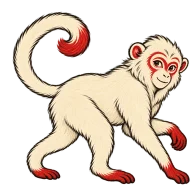

Year of the Monkey in the Chinese Zodiac: 1992, 2004, 1980 and 2028

The Monkey years are 1932, 1944, 1956, 1968, 1980, 1992, 2004, 2016, and 2028. New Year, not 1 January, opens each one, and it moves every winter between late January and mid-February. If you were born early in the year, check the exact dates in the table.

戊申 · 2028

The next Monkey year: 2028, an Earth Monkey

Starts (Chinese New Year)
Ends
The Monkey after that
2040 (庚申)

Monkey birth years: start and end dates

Every Monkey year from 1932 to 2028, with its first and last day, your age in 2027, and its Na Yin element, a second traditional element read from the whole year name (Vietnamese sites call it mệnh).

Monkey birth years: start and end dates
Gregorian YearElement · Na Yin elementLunar New YearYear endsAge at end of 2027Nominal age in 2027 (虛歲)
1932壬申 Water剑锋金Gold of the sword edge94–9596
1944甲申 Wood井泉水Water of the spring82–8384
1956丙申 Fire山下火Fire at the foot of the mountain70–7172
1968戊申 Earth大驿土Earth of the great post road58–5960
1980庚申 Metal石榴木Pomegranate wood46–4748
1992壬申 Water剑锋金Gold of the sword edge34–3536
2004甲申 Wood井泉水Water of the spring22–2324
2016丙申 Fire山下火Fire at the foot of the mountain10–1112
2028戊申 Earth大驿土Earth of the great post road––

Born in January or February? Check your date

Two Monkeys born in the same lunar year, one in March and one the following January, end 2027 a year apart, so the top line shows a range. The line under it counts the old way (虛歲, tuổi mụ): you are 1 on the day you are born and gain a year each Chinese New Year, not on your birthday.

Wood or Water? The two elements of a 2004 Monkey

Most English charts list 2004 under Wood, because its stem, 甲, belongs to Wood. Its Na Yin element is Water: that reading takes the whole name, 甲申, whose Na Yin is 井泉水 (Water of the spring). Both are traditional labels, read from different parts of the name.

A baby born before January 22, 2004 gets a different answer. They belong to 癸未, the Goat year, whose Na Yin is 杨柳木 (Willow wood), so Wood.

For 戊申 Vietnamese sites usually write Đại Trạch Thổ, while 三命通會 has 大驛土 (Đại Dịch Thổ), “earth of the great post road”. Both names mean the same pair.

Born before New Year in a Monkey year?

Then you belong to the Goat year before it, and a Monkey year never shares its Na Yin element with that Goat year. Find your year here:

1932: born up to Feb 5, 1932
辛未, Earth by the roadside (Earth)
1944: born up to Jan 24, 1944
癸未, Willow wood (Wood)
1956: born up to Feb 11, 1956
乙未, Gold in the sand (Metal)
1968: born up to Jan 29, 1968
丁未, Water of the Milky Way (Water)
1980: born up to Feb 15, 1980
己未, Fire in the sky (Fire)
1992: born up to Feb 3, 1992
辛未, Earth by the roadside (Earth)
2004: born up to Jan 21, 2004
癸未, Willow wood (Wood)
2016: born up to Feb 7, 2016
乙未, Gold in the sand (Metal)
2028: born up to Jan 25, 2028
丁未, Water of the Milky Way (Water)

What the Monkey is like

The traits, lucky colors and numbers below are cultural associations. They do not establish a person’s character or predict outcomes.

猴, the watcher

Li Shizhen’s 16th-century Bencao Gangmu explains the character by quoting the Han-dynasty Baihutong: 猴 is read as 候, to watch and wait. When a monkey sees people setting out food or a trap, it climbs high and looks around first.

Bencao Gangmu, the macaque entry (Wikisource)

Five kinds of Monkey

Water, Wood, Fire, Earth or Metal: the element in a Monkey’s name comes from the heavenly stem of its year, and the stem moves on each time 申 comes round. Years sixty apart share the same name.

  • Wood Monkey

    甲申 · jiǎ shēn

    Element (洪範)
    Wood bends, straightens
    木曰曲直
    Image (三命通會)
    a sweet well
    甘井
    Na Yin element
    Water of the spring · Water
    井泉水
  • Fire Monkey

    丙申 · bǐng shēn

    Element (洪範)
    Fire flames upward
    火曰炎上
    Image (三命通會)
    wild grass burning in the fields
    白茅野燒
    Na Yin element
    Fire at the foot of the mountain · Fire
    山下火
  • Earth Monkey

    戊申 · wù shēn

    Element (洪範)
    Earth is sown and reaped
    土爰稼穡
    Image (三命通會)
    fields in autumn
    秋間田地
    Na Yin element
    Earth of the great post road · Earth
    大驛土
  • Metal Monkey

    庚申 · gēng shēn

    Element (洪範)
    Metal can be reshaped
    金曰從革
    Image (三命通會)
    pomegranate blossom
    榴花
    Na Yin element
    Pomegranate wood · Wood
    石榴木
  • Water Monkey

    壬申 · rén shēn

    Element (洪範)
    Water soaks and sinks
    水曰潤下
    Image (三命通會)
    halberds
    戈戟
    Na Yin element
    Gold of the sword edge · Metal
    劍鋒金

Personality Traits

People born in the Year of the Monkey are inventive, quick-witted, and endlessly inquisitive. They absorb new knowledge rapidly and pivot effortlessly in unfamiliar situations. Their vibrant curiosity and mischievous charm make them brilliant, out-of-the-box problem-solvers.

Lucky Numbers
4, 9
Lucky Colors
White, Blue, Gold
Yin/Yang
Yang
Fixed Element
Metal
Famous People Born in the Year of the Monkey
Leonardo da Vinci, Charles Dickens, Will Smith, Selena Gomez
View Monkey horoscope today

Monkey compatibility: what the traditional rules say

The Snake: on the best list and the difficult list

The Snake is on both lists above. 巳申 is one of the six harmony pairs, and 寅巳申 is also a punishment group. No other two signs are both.

And the Horse?

Monkey and Horse (申午) have no relation either way in the classical tables: no harmony and no clash. The two meet in old stable lore instead, further down this page.

Monkey (申) and Snake (巳) form a Liu He pair (六合). Monkey, Rat (子) and Dragon (辰) belong to the same San He trio (三合); two signs alone are not the full three-branch formation. Monkey and Tiger (寅) sit opposite one another in the Six Clashes (六冲), while Pig (亥) is its Six Harms pairing (六害).

The ring shows the twelve earthly branches with Rat (子) at the top, running clockwise. Lines mark how Monkey (申) relates to the other branches in the classical tables.

Six Harmony (六合)
Snake (巳)
Three Harmony (三合)
Rat (子), Dragon (辰)
Clash (六沖)
Tiger (寅)
Harm (六害)
Pig (亥)
Punishment (刑)
Tiger (寅), Snake (巳)

A triangle on a branch marks Xing (刑) punishment with Monkey.

These are classical branch labels, not compatibility scores. To compare two signs, use the compatibility checker.

These are traditional branch relationships, not measured marriage probabilities or a reason to reject a partner. The classical rules describe a larger chart; a year-animal comparison uses only part of it.

Compare any two signs in the compatibility checker

2028, the Earth Monkey year

戊申 comes back once every sixty years. Its last turn was 1968; this one opens on January 26, 2028 and closes on February 12, 2029.

384 days, 13 lunar months: Jan 26, 2028 to Feb 12, 2029

  1. Chinese New Year
  2. Li Chun, the start of spring
  3. Lantern Festival
  4. Dragon Boat Festival
  5. Mid-Autumn Festival
  6. Li Chun, the start of spring
  7. Last day of the year

The shaded month is a leap month: a second 5th month of 29 days, starting on Jun 23, 2028.

384 days and two springs

13 moons fit inside this year instead of twelve. The extra one is a second 5th month (閏月), shaded on the ribbon. The year also catches Li Chun twice, on February 4, 2028 and again on February 3, 2029, which almanacs call a double-spring year (雙春).

If a baby arrives early in 2028, the date decides the sign. Up to January 25, 2028 the calendar is still in 丁未, the Goat year, and Monkey births start on January 26, 2028.

A round birthday for every Monkey in 2028

If you were born after New Year in a Monkey year, you turn a multiple of twelve in 2028. Those born in 1968 reach sixty and meet their own stem and branch, 戊申, again.

  • 12 · born 2016
  • 24 · born 2004
  • 36 · born 1992
  • 48 · born 1980
  • 60 · born 1968
  • 72 · born 1956
  • 84 · born 1944
  • 96 · born 1932

Why 2028 is called Earth Monkey

The stem 戊 belongs to Earth and 申 is the Monkey’s branch, so 戊申 reads as Earth Monkey.

The branch 申 counts as Metal in every Monkey year, so only the stem changes. After 2028, 戊申 returns in 2088.

Monkey and Tai Sui in 2028

In Chinese folk tradition each lunar year has a presiding Tai Sui (太歲), the year’s guardian deity. The Tai Sui of 2028 belongs to the Monkey branch (申). Traditional almanacs list the animals that stand in a set relation to it.

  • Own year (值太歲, Ben Ming Nian)

Monkey is the animal of 2028. This is the 12-year return called Ben Ming Nian (本命年). In folk tradition, people born under this sign “meet” the Tai Sui because they share its branch.

Common customs are wearing red, carrying a jade charm and visiting a temple early in the year to ask for the Tai Sui’s blessing (安太歲). Practices differ by region and temple.

This is a traditional classification. It is not a forecast, and it does not show that anything good or bad will happen to you.

Background: Tai Sui (Wikipedia)

Other animals that meet the 2028 Tai Sui

  • TigerClash (沖太歲), Punishment (刑太歲)
  • SnakePunishment (刑太歲)
  • PigHarm (害太歲)

Before its own year the Monkey has a calm run, with no Tai Sui relation in 2026 and 2027. Its last one was punishment in 2025, a Snake year. After 2028, the next are harm in 2031 and clash plus punishment in 2034.

Born in January or February?

Monkey years have begun as early as January 22, 2004 and as late as February 16, 1980. Born before that year’s New Year, you count in the Goat year before it. The birthday check gives the answer for any date.

BaZi (八字, the Four Pillars) ignores New Year and turns the year at Li Chun, the start of spring, in early February. For a few days most winters the two methods give different animals, as the examples further down show.

BaZi: check the birth time

Is your birthday in a Year of the Monkey?

Your date stays in this browser. It is not saved or sent anywhere.

February 4, 1992: New Year and Li Chun on one day

In 1992 the two starting points met. Chinese New Year fell on February 4, 1992, and so did Li Chun, so the gap that splits most Monkey years shrank to a single day.

Even that day has two answers. By the calendar, anyone born on February 4, 1992 is a Monkey (壬申) from midnight. BaZi waits for Li Chun, which came at 21:48 Beijing time, so a birth earlier that day keeps the Goat year pillar, 辛未.

In the whole 1924–2035 table, New Year and Li Chun share a day only in 1924, 1943, and 1992.

  • 辛未: Goat
  • 壬申: Monkey

January and February birthday examples

These examples use the Chinese civil calendar. Compare the two conventions rather than assuming that January 1 or February 4 is always the cutoff.

1980 · 庚申 · Metal

On February 15, 1980, the Chinese New Year sign is still Goat. From February 16, 1980 through February 4, 1981, inclusive, it is Monkey.

These conventions use different year boundaries. Here is the result for February 15, 1980 under each:

Lunar New Year convention (civil / public)
Year boundary: February 16, 1980
Resulting sign: Goat (己未)
Li Chun convention (solar / BaZi)
Year boundary: February 5, 1980, 00:09 UTC+8
Resulting sign: Monkey (庚申)
Check 1980 in the HKO calendar

2004 · 甲申 · Wood

On January 21, 2004, the Chinese New Year sign is still Goat. From January 22, 2004 through February 8, 2005, inclusive, it is Monkey.

These conventions use different year boundaries. Here is the result for January 22, 2004 under each:

Lunar New Year convention (civil / public)
Year boundary: January 22, 2004
Resulting sign: Monkey (甲申)
Li Chun convention (solar / BaZi)
Year boundary: February 4, 2004, 19:56 UTC+8
Resulting sign: Goat (癸未)
Check 2004 in the HKO calendar

Li Chun has an exact time. These examples avoid the changeover day; a birth on that day needs a time-based BaZi calculation. The date-only zodiac calculator compares civil days.

Boundary conventions: Hong Kong Observatory explanation

1968: the last Earth Monkey, and Tết a day early

Vietnam celebrated Tết Mậu Thân on January 29, 1968, a day before China’s New Year on January 30, 1968. It was the first Tết after North Vietnam set its calendar to Hanoi time in August 1967, and the same year also ended a day early, in 1969.

1968: Tết on January 29, 1968

Born on January 29, 1968: Goat (丁未) by the Chinese calendar, Monkey (戊申) by the Vietnamese calendar.

  • 丁未: Goat year
  • 戊申: Monkey year
  • Days on which the two calendars disagree

The new moon that opened the year came at 16:29 UTC: 23:29 in Hanoi, still on January 29, 1968, but 00:29 in Beijing, already the next day.

1969: the Monkey year ends a day early

Born on February 16, 1969: Monkey (戊申) by the Chinese calendar, Rooster (己酉) by the Vietnamese calendar.

  • 戊申: Monkey year
  • 己酉: Rooster year
  • Days on which the two calendars disagree

It happened again a year later. The new moon came at 23:25 Hanoi time on February 16, 1969, and at 00:25 Beijing time the day after.

North and South in 1968

In 1968 only the North used the new calendar. South Vietnam kept the older one and held Tết on January 30, 1968, the same day as China. Calendars printed in Vietnam today use Hanoi time for every year, so they give January 29, 1968. Every other Monkey year, 2028 included, starts and ends on the same days in both calendars.

On these two days the birthday check on this page answers by the Chinese calendar.

The monkey in the stable

Why people who kept horses also kept a monkey, and how that custom gave the Monkey King his first job in heaven.

馬留, the stable monkey

In old China, people who kept horses would keep a monkey in the stable too, believing it warded off sickness in the herd. Li Shizhen’s 16th-century Bencao Gangmu records the custom under the macaque, and the nickname it gave the animal: 馬留 (mǎ liú).

In Journey to the West, the first post the Jade Emperor gives Sun Wukong is 弼馬溫, keeper of the heavenly horses. The scholar Qian Zhongshu read the title as a play on 避馬瘟, “ward off horse plague”, the very job of a stable monkey.

Monkey and Horse in the compatibility checker

Which calendar and animal names are used?

This page uses the Chinese calendar in UTC+8: Rabbit for 卯 and Ox for 丑. Vietnamese tradition uses Cat for Mão and Water Buffalo for Sửu. Vietnamese calendar dates use UTC+7 and can differ, so translating a branch name does not convert the calendar.

In the year table the first element comes from the heavenly stem, as in most charts; the line under it is the Na Yin element from 三命通會. A Monkey year shares its Na Yin with the Rooster year after it, never with the Goat year before. Both labels are traditional and predict nothing.

Dates and Li Chun times are calculated with lunar-javascript using China Standard Time (UTC+8). Li Chun times are shown to the minute. The HKO tables below let you check lunar month starts and the stem-branch year names.

Questions about the Monkey

Years, ages, Na Yin elements, 1992, 2028, Tai Sui and Tết 1968.

1932, 1944, 1956, 1968, 1980, 1992, 2004, 2016, and 2028. Each Monkey year runs from one Chinese New Year to the day before the next, and the 2028 Monkey year begins on January 26, 2028.

2028, from January 26, 2028 to February 12, 2029: the Earth Monkey year 戊申, with the Na Yin 大驿土 (Earth of the great post road), Earth as well. The year lasts 384 days: 13 lunar months, because the 5th month repeats, and two Li Chun, on February 4, 2028 and February 3, 2029. A baby born before January 26, 2028 is still a Goat (丁未).

From February 4, 1992 on, yes: 壬申, with Water as its stem element and Metal as its Na Yin element (剑锋金, Gold of the sword edge). Births from January 1, 1992 to February 3, 1992 belong to the Goat year 辛未, Na Yin 路旁土 (Earth by the roadside). February 4, 1992 itself has two answers: Li Chun fell that day at 21:48, so BaZi still puts an earlier birth in the Goat year.

Both labels are in use. Its stem, 甲, is Wood, which is what most charts show. The Na Yin of 甲申, 井泉水 (Water of the spring), is Water, the answer Vietnamese sites give for mệnh. Born before January 22, 2004, though, you belong to 癸未, the Goat year, with Na Yin 杨柳木 (Willow wood, Wood). BaZi waits for Li Chun instead: February 4, 2004, 19:56 Beijing time.

Take someone from the 1992 Monkey year: they turn 34 or 35 in 2027, depending on the birthday, and their traditional age (虛歲, tuổi mụ) is 36. In 2028 they reach 36 if born after New Year, with a traditional age of 37. That year every Monkey turns a multiple of twelve: 12, 24, 36, 48, 60, 72, 84, and 96.

Yes. 2028 is the Monkey’s own year (本命年, 值太歲), so by tradition every Monkey meets the Tai Sui. The Tiger, Snake, and Pig meet it that year too, each by a different relation. The Monkey has no Tai Sui relation in 2026 and 2027; after 2028 the next are 2031 (harm) and 2034 (clash and punishment). None of this is a forecast.

Old tables pair the Monkey with the Rat and the Dragon, its three-harmony partners (申子辰), and with the Snake (巳申, six harmony). The harder matches are the Tiger (clash and punishment), the Pig (harm) and the Snake again, because 寅巳申 is a punishment group. No other pair of signs is both a harmony and a punishment. The Horse has no relation with the Monkey either way.

In August 1967 North Vietnam set its calendar to Hanoi time. The new moon that began the 1968 lunar year came at 16:29 UTC: 23:29 on January 29, 1968 in Hanoi, but 00:29 on January 30, 1968 in Beijing. So Tết Mậu Thân fell on January 29, 1968 in the North, and on January 30, 1968 in China and in the South, which kept the older calendar. The year ended a day early too: Tết 1969 was February 16, 1969 in Vietnam and February 17, 1969 in China. No other Monkey year, 2028 included, has such a gap.

Explore the Chinese Zodiac

Learn about the personality traits, luck, and meaning of the 12 Chinese Zodiac animals.